 LOOKSMAXXING
The Complete Skin Looksmaxxing Guide: Routine, Acne, Actives & Sunscreen
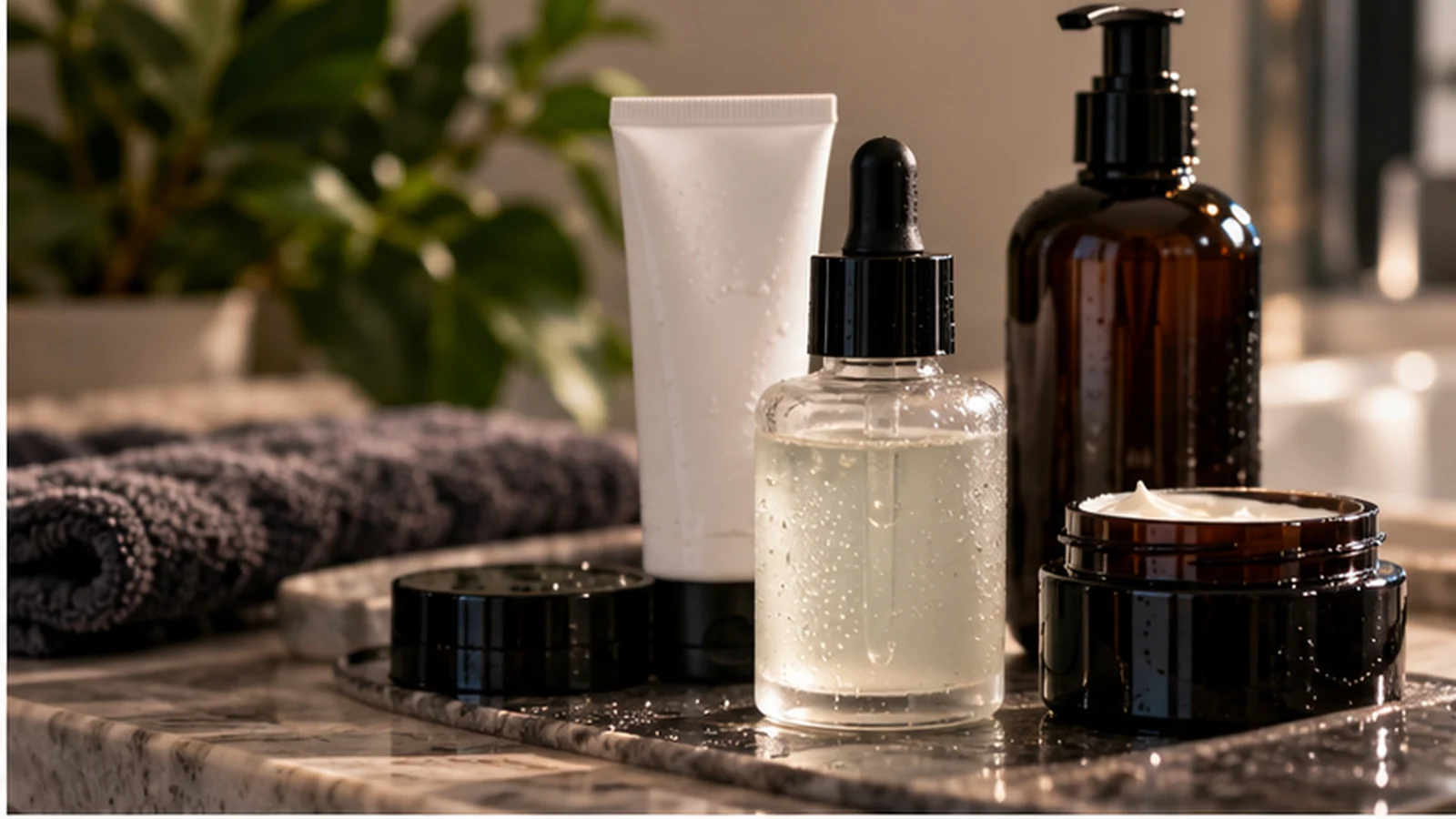
Good skin is one of the highest-return appearance projects because the basics are cheap, visible, and supported by actual dermatology. The mistake is treating skincare like a collectible hobby. Start with a stable three-step base, then add one active for one problem at a time.
1. The baseline: cleanse, moisturize, protect
The full beginner routine is not twelve products. It is three jobs. Clean without stripping. Replace water and barrier support after washing. Protect from ultraviolet exposure. Our dedicated walkthrough is The 3-Step Skincare Routine That Covers 80%.
Gentle cleanser
Use at night and after heavy sweating. Lukewarm water. If your skin feels tight or squeaky afterward, your cleanser is too aggressive.
Moisturizer
Pick texture by skin type, not marketing. Fragrance-free is a sensible default if you are reactive.
Broad-spectrum SPF 30+
Daily when exposed to daylight. A long randomized trial found regular sunscreen use slowed measured photoaging compared with discretionary use.
Consistency
The routine you run for years beats the expensive shelf you use for eleven days.
If your skin is irritated or your routine is chaotic, run cleanser + moisturizer + sunscreen alone for two weeks before adding an active. That gives you a readable baseline.
2. Acne: treat the mechanism, not just the surface
Acne is not a cleanliness failure. Scrubbing harder usually adds irritation without treating the main drivers. Current American Academy of Dermatology guidance strongly recommends topical retinoids and benzoyl peroxide among the core evidence-based options; combinations are common because different ingredients target different mechanisms.
| Problem | Useful ingredient | How to start | Main caution |
|---|---|---|---|
| Clogged pores / comedones | Adapalene or another topical retinoid | Pea-size amount, a few nights per week, then increase as tolerated | Dryness/irritation; pregnancy restrictions apply to retinoids |
| Inflamed acne | Benzoyl peroxide | Low strength can be enough; wash or leave-on formats both exist | Can irritate and bleach fabric |
| Oil + mild congestion | Salicylic acid | Use a few times per week rather than stacking with everything | Overuse can dry and sting |
| Post-acne marks / uneven tone | Azelaic acid | Start once daily or every other day | May tingle initially |
Do not start retinoid, benzoyl peroxide, salicylic acid, vitamin C, and an AHA peel on the same Monday. If your face becomes red and flaky, you have learned nothing about which ingredient helped. Add one variable, give it time, then decide.
Deep painful nodules, acne that scars, widespread acne, sudden severe changes, or months of failed over-the-counter treatment are good reasons to get professional care. The cost of waiting can be permanent scarring.
3. Texture, pigmentation and redness
Texture
Texture has multiple causes: dehydration, acne, clogged pores, scars, sun damage, or simply visible pores in unforgiving lighting. Moisturizer can make dehydrated texture look better quickly. Retinoids can help acne and photoaging over longer timeframes. True depressed acne scars usually need a dermatologist and procedures; no serum can fill missing dermal structure.
Dark marks
Post-inflammatory hyperpigmentation often fades slowly. The highest-value move is to stop creating new inflammation and protect the area from UV. Azelaic acid and retinoids can be useful depending on your skin and the cause. Picking at acne is a high-effort way to manufacture longer-lasting marks.
Redness
Redness can be irritation, acne, rosacea, dermatitis, shaving damage, or something else. If a "skincare routine" burns every time it goes on, simplify rather than adding a calming serum on top of the irritation stack. Persistent flushing or rash deserves diagnosis before optimization.
4. Actives: the useful ones and where they fit
Retinoids
Topical retinoids have strong evidence in acne and are also used for photoaging. They work slowly, and irritation is common early on. Start low-frequency, moisturize, and use sunscreen. More product does not make them work faster.
Vitamin C
Vitamin C can be a reasonable antioxidant/pigment adjunct, but formulation matters and unstable products can oxidize. It is optional, not a foundation step. If you are choosing between a vitamin C serum and sunscreen you will actually wear, pick the sunscreen.
Niacinamide
Niacinamide is common in moisturizers and can support barrier function and oil control for some people. You do not need a separate 10% serum just because the ingredient is popular. More concentration is not automatically more effective or less irritating.
Exfoliating acids
AHAs can improve surface texture and pigment; salicylic acid is oil-soluble and useful for some acne-prone skin. Think in terms of frequency, not intensity. One or two controlled exfoliation sessions per week often makes more sense than daily acid stacking.
5. Shaving without wrecking your face
Shaving irritation can make otherwise good skin look inflamed. Use a sharp blade, enough lubrication, and fewer passes. Shave with the grain if you are prone to ingrown hairs. If multi-blade cartridges repeatedly cause bumps, a simpler single-blade or electric setup may be easier on your skin. Persistent pseudofolliculitis can be treated medically, especially if it leaves dark marks or scars.
6. Tallow, "natural" skincare, pore vacuums and other internet detours
Natural is not a dermatology category. A product can be natural and irritating, synthetic and gentle, cheap and excellent, or expensive and useless. Tallow is an emollient fat; some people like how it feels. That is not evidence that it replaces sunscreen, treats acne better than established therapies, or is uniquely compatible with human skin.
- Physical scrubs: not required for clean skin; aggressive use can irritate.
- Pore vacuums: can temporarily remove surface material but can also cause bruising and broken capillaries if overused.
- Ice rollers: can temporarily reduce puffiness and feel good; they do not shrink pores permanently.
- DIY lemon/baking soda: skip it. Irritation is not exfoliation.
- Expensive eye cream: often a moisturizer in a smaller jar. Identify whether your issue is pigment, swelling, anatomy, or irritation first.
7. Build the routine around your skin type
"Oily," "dry" and "combination" are useful descriptions, not permanent identities. Weather, shaving, medication, acne treatment and over-cleansing can change how your skin behaves. Choose textures based on what your face is doing now.
| Skin behavior | Cleanser | Moisturizer | What to watch |
|---|---|---|---|
| Oily / acne-prone | Gentle gel or low-foam cleanser | Light lotion or gel-cream | Do not strip oil so aggressively that everything burns |
| Dry / tight | Creamy, low-foam cleanser; sometimes water-only in the morning | Richer cream with humectants + occlusives | Hot water, fragrance, frequent acids |
| Combination | Gentle all-over cleanser | Light all-over, richer only where needed | Treat zones differently instead of buying a harsher cleanser |
| Sensitive / reactive | Short ingredient list, fragrance-free | Simple barrier-focused cream | Add actives one at a time and patch test |
8. Sunscreen without turning it into a moral lecture
Sunscreen is useful because ultraviolet exposure is cumulative. The best product is the one you can apply enough of and tolerate every day. Broad-spectrum SPF 30 or higher is a sensible baseline. If one formula pills, stings your eyes or looks awful on your skin tone, switch formulas rather than concluding sunscreen itself is impossible.
- Chemical vs mineral: both categories can work. Texture, eye sting and cosmetic finish often matter more in daily use.
- Tinted formulas: can reduce visible white cast and may be useful for people managing pigment because iron oxides can add visible-light protection.
- Reapplication: matters most with prolonged outdoor exposure, sweating, swimming or wiping the face. An office day is not a beach day.
- Hats and shade: still count. Sun protection is a system, not a single bottle.
9. Product order and mixing without chemistry theater
In the morning: cleanse if needed, treatment serum if you use one, moisturizer if needed, sunscreen last. At night: cleanse, treatment, moisturizer. You can reverse treatment and moisturizer when buffering an irritating retinoid. There is no prize for the most technically elaborate layering sequence.
The combinations most likely to cause trouble are usually not "toxic" combinations; they are irritation combinations. Retinoid + strong AHA + benzoyl peroxide + aggressive shaving can be too much for one face even if each ingredient is valid alone. Simplify when stinging, redness, peeling or tightness appears.
10. Diet, sleep and supplements
Skincare cannot fully compensate for poor sleep, smoking, or constant skin picking. Diet-acne relationships vary by person and evidence is not a license for extreme food restriction. If you notice a reproducible trigger, test it calmly rather than cutting ten foods at once. For supplements, be skeptical of "skin detox" claims. Correcting a true deficiency can matter; megadosing random vitamins usually is not the missing step.
The 8-week skin plan
- Week 1-2: cleanser, moisturizer, sunscreen only. Photograph your skin in the same lighting once per week.
- Week 3: choose one active tied to one goal. Acne: consider adapalene or benzoyl peroxide. Pigment: azelaic acid may be reasonable. Do not add three.
- Week 4-5: adjust frequency based on irritation. If your barrier is angry, reduce active frequency and moisturize.
- Week 6: audit shaving, pillowcases, helmets/hats, and anything that repeatedly rubs or occludes the same acne-prone area.
- Week 8: compare photos. Keep the routine if it is moving the problem. Escalate to a dermatologist if it is not, especially for scarring or painful acne.
For the exact minimalist product criteria and a deeper sunscreen breakdown, use The 3-Step Skincare Routine That Covers 80%. Then put skin in context with The Looksmaxxing Hierarchy.
Selected references
- Hughes MCB, Williams GM, Baker P, Green AC. Sunscreen and prevention of skin aging: a randomized trial. Ann Intern Med. 2013;158(11):781-790. PubMed.
- American Academy of Dermatology. Updated guidelines for management of acne. 2024. AAD.
- American Academy of Dermatology. Acne: diagnosis and treatment. AAD.