The 14-Day Facial Debloat Protocol
Water retention is the only part of your face that can visibly change in two weeks. Here's what actually drives it, which lever is doing most of the work, and the protocol that follows from the evidence rather than from TikTok.
Facial debloating is real, fast, and worth doing — but it is not the salt story the community tells. In healthy men, the measured driver of overnight facial fluid is alcohol and sleep debt, not sodium. Fix those two and most of the puffiness goes with them.
It earns PARTIAL rather than WORKS for one reason: debloating reveals the face you already have. It does not build a jawline, and if the underlying structure is soft because of body fat, no amount of sodium math will change that. The ceiling is real and you should know where it is before you start.
Start here: what "bloat" actually is
When your face looks softer on Tuesday than it did on Saturday, almost nothing structural has changed. Bone hasn't moved. Fat doesn't relocate on a 48-hour timescale. What changed is where the water in your body is sitting.
Your body holds fluid in two broad compartments: inside your cells (intracellular) and outside them (extracellular — which includes blood plasma and the interstitial fluid soaking the tissue between cells). Facial puffiness is interstitial fluid pooling in the soft tissue of your face, and it concentrates in the places with the loosest, thinnest tissue: your eyelids, under-eyes, and the area under your jaw.
This is also why it's worst in the morning. You spent eight hours horizontal, and gravity stopped pulling fluid toward your feet. Within an hour or two of standing up, a meaningful chunk of it drains on its own.
Debloating is not a transformation. It is removing an artifact. The face underneath was always there — you were just photographing it through a layer of retained water. That's a genuinely useful thing to fix, and it is the fastest legitimate win available to most guys. It is also finite. Two weeks in, you'll be looking at your actual face, and everything after that is a slower project.
Claim check: is it the salt?
This is where nearly every debloat guide on the internet goes wrong, so it's worth being careful.
The intuitive model says: eat salt, retain water, get puffy. But this was tested directly. Heer and colleagues ran 32 healthy men through a metabolic ward on controlled sodium intakes ranging from roughly 50 to 550 mEq of NaCl per day.[5] Higher sodium raised plasma volume in a dose-dependent way — but it did not raise extracellular volume or total body water.
In other words: in healthy young men with working kidneys, chronically higher salt intake redistributed fluid into the bloodstream rather than dumping it into the tissue where puffiness lives. Your kidneys are extremely good at this. They are, functionally, a sodium disposal system operating at industrial capacity.
The trials where sodium restriction does visibly reduce extracellular fluid are in people whose kidneys are compromised. The LowSALT CKD crossover trial found whole-body extracellular volume dropped by about a litre on a sodium-restricted diet — but that was in patients with stage 3–4 chronic kidney disease.[6] That result is real and important. It is also not you.
What's left that's true: a single very high-sodium meal genuinely does cause short-term local fluid shifts and thirst, and if you eat a 4,000 mg sodium takeaway at 11pm and photograph yourself at 7am, you will see it. That's an acute, meal-timing effect — not a chronic one. Cutting your average sodium from 3,500 to 2,300 mg per day will do far less for your face than the internet promises.
What the evidence actually points at: alcohol
Here is the study the debloat guides should be citing and don't.
Taivainen and colleagues gave eight healthy men either ethanol (1.2 g/kg — roughly six to seven standard drinks for an average-sized man) or an equal volume of fruit juice between 6pm and 9pm, then measured what their kidneys did overnight.[3] The first three hours went as expected: alcohol suppressed vasopressin, urine output shot up, and the men lost fluid. That's the well-documented mechanism — ethanol reduces vasopressin release, which drops the kidney's water-retention signal and produces hypotonic diuresis.[4]
Then it reversed. From midnight to 6am, the men entered a phase of antidiuresis — vasopressin levels ran higher than in the control session, and their kidneys clamped down on water. When the researchers gave everyone a water load the next morning, the alcohol group retained 44% of it, versus 12% in controls.
Your body doesn't just lose water when you drink. It overcorrects. You dehydrate for three hours, your system responds, vasopressin can rebound, and you can spend the back half of the night retaining more water — while lying horizontal. That is the exact recipe for a puffy face, and it is one common reversible input.
It also explains why "drink a glass of water between drinks" only half works. It blunts the dehydration phase. It does not stop the rebound.
There's a second-order effect worth naming honestly, because it cuts against the puritan version of this advice: at low doses, alcohol's vasodilation increases facial flushing, which reads as healthy colouring. A University of Bristol study found roughly one drink made people appear slightly more attractive to raters — with the effect disappearing at higher doses.[7] One drink is not your problem. Five on a Saturday is.
The other big lever: sleep
Sleep loss is the one input where the effect on your face has been measured directly, by photograph, with rated outcomes.
Sundelin and colleagues at Karolinska photographed ten people twice — once after normal sleep, once after 31 hours of sleep deprivation following a night of only five hours — and had forty observers rate the images.[1] The sleep-deprived faces were rated as having more swollen eyes, more hanging eyelids, darker under-eye circles, redder eyes, paler skin, more fine lines, and more droopy mouth corners. Every cue that the looksmaxxing community obsesses over — under-eye support, eye area, skin tone — moved in the wrong direction from one bad night.
The follow-up work went further: restricted sleep didn't just change how faces looked, it changed how people responded to those faces — sleep-restricted individuals were rated as less attractive and less socially appealing, and observers reported less desire to socialise with them.[2]
This is worth sitting with, because sleep is the least glamorous item in all of looksmaxxing and it outperforms every product in this category. You cannot buy it, nobody makes commission on it, and it beats every eye cream ever formulated.
The 14-day protocol
Three levers, ranked by measured impact. Do the first two properly and the third is almost decorative.
| Lever | What to actually do | Expected contribution |
|---|---|---|
| ALCOHOL | Zero for 14 days. Not "reduced" — zero. This is the whole point of the two-week window: it's long enough to clear the rebound cycle and short enough to actually finish. | Largest. Direct rebound-antidiuresis mechanism, measured at 44% vs 12% water retention.[3] |
| SLEEP | 7–9 hours, consistent bed and wake times, including weekends. Consistency matters more than any single long night. | Large. The only lever with photographed, rated facial outcomes.[1] |
| SODIUM TIMING | Don't chase a daily number. Just stop eating high-sodium food in the 4 hours before bed. Move the pizza to lunch. | Modest. Acute and local. The chronic-intake story is largely unsupported in healthy men.[5] |
| WATER | Drink enough that your urine is pale. That's it. There is no debloating benefit to a gallon a day, and dehydration triggers exactly the retention response you're trying to avoid. | Supporting. Prevents you from making it worse. |
| MORNING DRAIN | Get vertical, get moving, get 20 minutes of light activity. Gravity and muscle pump do the work. Cold water on the face is fine and mildly vasoconstrictive — it is not doing anything special. | Cosmetic, same-day. Speeds up what would happen anyway. |
Week 1 vs Week 2
Days 1–4: You will probably look slightly worse before you look better, particularly if you're coming off a heavy weekend. Fluid redistribution isn't instant and sleep debt takes several nights to clear. Do not photograph yourself here and do not draw conclusions.
Days 5–10: This is where the change shows up. Under-eyes first, then the jaw and submental area. Most of your total result is banked by day 10.
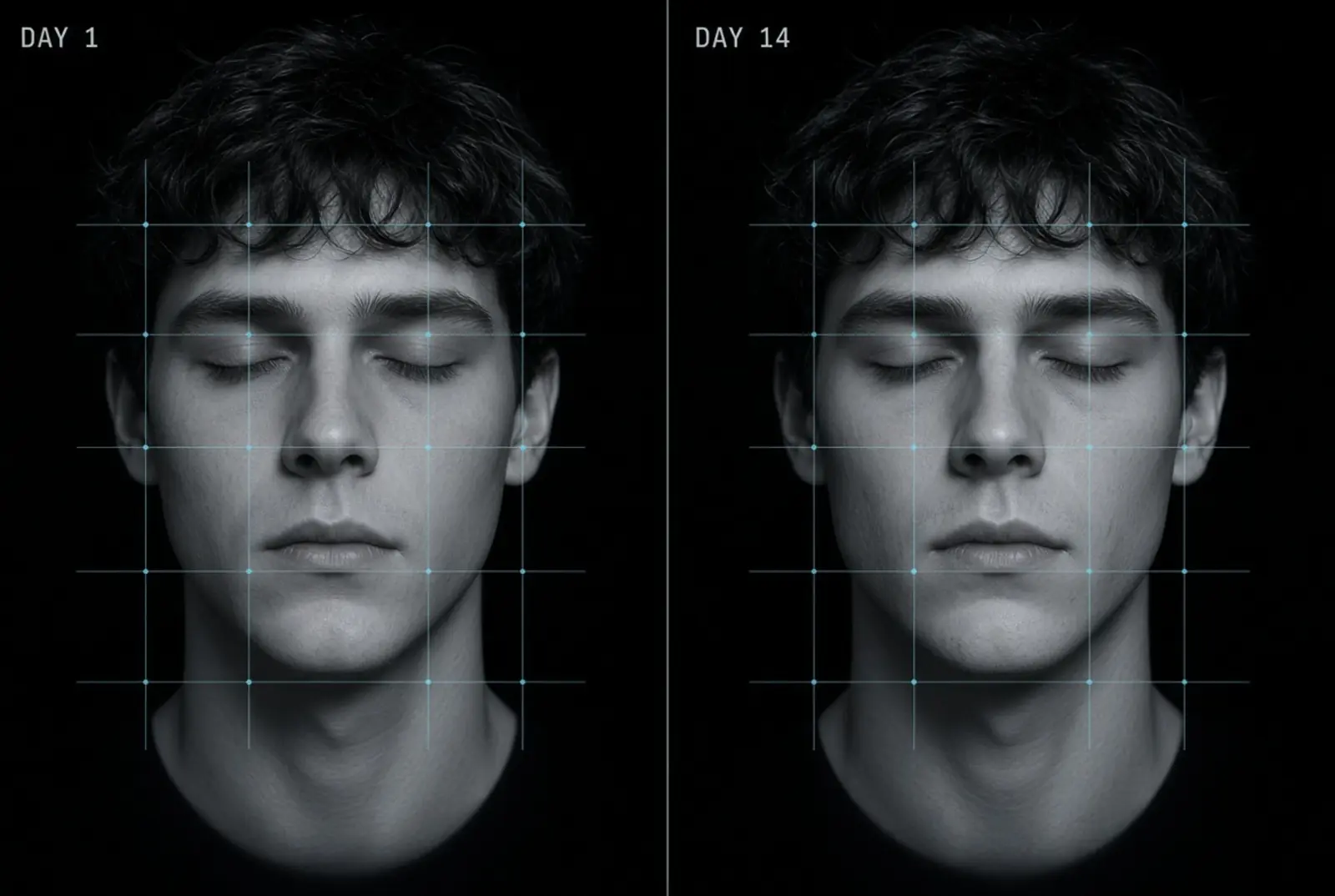
Days 11–14: Stabilisation. What you see on day 14 is roughly your actual baseline face at your current body composition.
Take a day-0 photo and a day-14 photo under identical conditions: same time of morning, same room, same light source, same distance, neutral expression, no smiling, camera at eye level and at least an arm's length away. If you change the angle or the lens distance you will produce a "result" that is entirely artificial — and that's a mistake with its own article on this site.
What this protocol will not do
Being clear about the ceiling is the difference between a useful tool and a cope.
- It will not give you a jawline you don't have. Mandible shape is bone. Debloating removes what's sitting on top of it.
- It will not replace body composition work. If your submental area is soft because of body fat rather than fluid, day 14 will look a lot like day 0. That's information, not failure — it tells you the real project is elsewhere.
- It is not permanent. It's a behaviour, not an outcome. The result persists exactly as long as the behaviours do.
- It will not fix your under-eyes if they're structural. Tear trough hollowing and pigmentation from genetics don't respond to fluid management.
- Diuretics. Prescription or "herbal." People have died doing this for aesthetics. Deliberately deranging your electrolytes to look better in a photo is one of the worst risk-to-reward trades in this entire space, and the effect is temporary regardless.
- Water loading and cutting. The bodybuilding stage-prep protocol is a supervised, one-day, genuinely dangerous procedure done for a specific competitive reason. It is not a lifestyle and it is not for a night out.
- Extreme sodium restriction. Sodium is an essential electrolyte. Driving it very low causes fatigue, headaches, and impaired training performance in exchange for a benefit the metabolic-ward data suggests is small.[5]
- Anything sold as a "debloat supplement." There is no ingredient in this category with evidence behind it for facial appearance. The protocol above costs nothing.
Where this sits in the hierarchy
Debloating is a tier-one softmaxx: high speed, low cost, low risk, capped ceiling. It belongs at the very start of any serious plan precisely because it's capped — it clears the noise so you can see what you're actually working with, and it stops you making decisions about your face based on a photo of retained water.
The mistake is treating it as the destination. Two weeks of clean sleep and no alcohol shows you your real baseline. What you do with that information — training, body composition, skin, grooming — is the actual work.
The Looksmaxxing Hierarchy
Every method ranked by impact-per-effort. Debloating sits near the top for speed and near the bottom for ceiling — here's why both are true.
CopeSelfie Distortion: The Reality Check
Before you judge your day-14 photo, understand what your front camera is doing to your face at arm's length. Roughly 30% nasal distortion at 12 inches.
CopeMastic Gum for Jawline: The Verdict
The other big "two weeks to a jawline" claim. A six-month RCT raised bite force and changed nothing about jaw shape.
DangerousBone Smashing: A Complete Teardown
Where the "my jaw changed in two weeks" claim goes when it stops being fluid and starts being trauma. Verdict: DANGEROUS.
References
- Sundelin T, Lekander M, Kecklund G, Van Someren EJW, Olsson A, Axelsson J. Cues of fatigue: effects of sleep deprivation on facial appearance. Sleep. 2013;36(9):1355–1360. doi:10.5665/sleep.2964
- Sundelin T, Lekander M, Sorjonen K, Axelsson J. Negative effects of restricted sleep on facial appearance and social appeal. Royal Society Open Science. 2017;4(5):160918.
- Taivainen H, Laitinen K, Tähtelä R, Kilanmaa K, Välimäki MJ. Role of plasma vasopressin in changes of water balance accompanying acute alcohol intoxication. Alcoholism: Clinical and Experimental Research. 1995;19(3):759–762.
- Leppäluoto J, Vuolteenaho O, Arjamaa O, Ruskoaho H. Plasma immunoreactive atrial natriuretic peptide and vasopressin after ethanol intake in man. Acta Physiologica Scandinavica. 1992;144(2):121–127.
- Heer M, Baisch F, Kropp J, Gerzer R, Drummer C. High dietary sodium chloride consumption may not induce body fluid retention in humans. American Journal of Physiology — Renal Physiology. 2000;278(4):F585–F595.
- McMahon EJ, Bauer JD, Hawley CM, et al. A randomized trial of dietary sodium restriction in CKD. Journal of the American Society of Nephrology. 2013;24(12):2096–2103. (LowSALT CKD study.)
- University of Bristol. Moderate alcohol consumption increases attractiveness. News release, 5 March 2015. (Institutional press release describing the low-dose facial flushing effect; cited as such, not as primary literature.)